Friday, March 12, 2010

William Miller, Elberta Peaches, and the Ohio Connection


William Miller, Elberta Peaches, and the Ohio Connection


In our modern prepackaged, throwaway society, there seems to be nothing more natural than that fuzz coated morsel of nature, the peach. It is unfortunate that for most of us, eating a peach involves opening a can full of syrup, and digging out either squishy or crunchy chunks tasting mainly of refined sugar and recognized as a peach only because its color is vaguely yellow.

Yet those who are wily still can find and appreciate a variety of fresh peaches. One of our comrades in peach appreciation was a farmer from our own backyard. William Miller, a farmer and orchardist near Port Clinton, grew peach trees, and perhaps by being a cheapskate, gave to us in Ohio a great natural gift: the freestone, yellow, tasty Elberta peach.

Peaches have a lengthy history. The ancient Greeks knew about peaches, but as with so many things, the Chinese were familiar with peaches long before. Kung Futzu (Confucius) mentioned peaches, and China was growing peaches thousands of years before the Greeks. North America was introduced to peaches in 1629. Peach orchards were widely planted in the United States in the years following the Revolution. American peach growing hit a peak in the years from 1875 to 1890, when disease caused a decline in the business.

In the meantime, Elberta peaches were becoming America’s favorite variety of peach. They originated in Marshallville, Georgia in about 1870, when a farmer named Samuel H. Rumph planted pits from a Chinese Cling peach tree. The tree that grew from some of these seeds was pollinated by who-only-knows what natural orchard. Rumph, whose wife’s name was Elberta, named the fruit of this tree after his spouse at the suggestion of friends of hers who had tasted them. Elberta peaches spread throughout the American South, California and even to Michigan.

Cut now to our Ohio orchardist, William Miller. Born in 1844, he was a native of Portage Township in Ottawa County, Ohio. He served in the Union army during the Civil War. A modest man, Miller was fascinated with fruit, and while he owned a fine farm, also tinkered with fruit varieties. He planted his first orchard near Gypsum, Ohio, in 1868. Allegedly he considered grapes first, but his devout father gently suggested that he plant anything but the source of wine. But he did raise Bartlett pears, Baldwin apples, English walnuts, and a variety of other trees.

Miller was fond of fruit, and was always looking for something new. In 1892, a chance acquaintance with a man from Georgia tipped him off to the existence of the Elberta peach. He learned that there were one thousand Elberta trees ready to be planted, and he purchased them and planted them, the first Elbertas in Ohio. Curious neighbors watched the experiment, and were astounded when the crop brought as high as $3.25 a bushel. The Miller family proudly preserved the purchase receipt for the purchase of those first Ohio Elbertas.

Miller’s Gypsum-area farm contained 190 acres at the beginning of the twentieth century, about 55 of it in peaches. Apples, cherries, pears, plums, and a handful of cattle in a mixture of pasture and woodlot made up the rest. Oddly, Miller grew about eight acres of tomatoes, but he did that mainly to keep his orchard helpers busy during the off season. Between pruning, spraying, and harvesting there was little time wasted. Miller preferred married men as laborers, believing them to be more “reliable.”

William Miller was an active businessman in the Catawba Island fruit farming industry. He served as president of the Ohio Horticultural Society, and took an interest in the Elberta Hotel, where fruit brokers stayed when buying up the year’s crop. He lived in a fine house near Gypsum, and turned a profit which, if not spectacular, was solid. Death came to Miller January 28, 1914.

The world of orchards and fruit packing in Ottawa County has declined to a shadow of its former self. In the 1920s, roadside stands began to replace the commercial fruit companies. Always marginal because of spring cold snaps which killed peach blossoms, many farmers gave up growing fruit on the Catawba peninsula. Suburban sprawl has also taken its toll, as vacation homes and tourism have taken the place of fruit trees as the main land use of the area.

There may no longer be many chances to see peach blossoms flickering in spring sunlight, or smell the heady fragrance of peach picking, or taste peach juice rolling down your chin. But if you do see a roadside stand in the neighborhood of Port Clinton that advertises fresh Elberta peaches, get one, and think of modest William Miller. He would approve of your choice.


[The Miller family has a vast collection of letters, papers, and photographs at the Center for Archival Collections, Bowling Green State University. From it, I found especially helpful material in the October 27, 1904 edition of The National Stockman and Farmer, and an unattributed obituary clipping by one S. R. Gill. H. P. Gould, Peach-Growing (New York, 1918), discusses the origins of peach growing on pp. 1-4, 10-11.]

George Baker Gives Witness to Toledo in 1876


Another from Bend of the River.

George Baker Gives Witness to Toledo in 1876

I read lots of mail. I get my share of junk mail, email, and the occasional “real” letter, but I also spend time reading the mail of long ago. As a historian who is also a stamp collector, I often get to look at letters saved in archives and libraries, and the occasional stamp show or postcard box at flea markets. And it is fun (to me) to read past the ancient health complaints and family news to find an occasional reference to national or state affairs. Such news is contained at a letter that came to hand from one George Baker.

George Baker (1832 -1910) did many different things during his lifetime. He was a nurseryman, and co-owned a commercial nursery in Toledo on Bancroft Street called Fahnestock and Baker. Baker’s 1910 obituary described him as “an enthusiastic horticulturist.” But during his time as a nurseryman, Baker also was president of the Metropolitan Street Railway, which in 1872 built a pioneering streetcar line from Summit to Lagrange. This streetcar route was not a financial success, so an expanded route was formed in 1878. Baker’s streetcars ran on Cherry Street, Bancroft, and St. Clair Avenue, and later reached Broadway in the South End In 1880, he was worth $60,000 in combined real and personal property, and lived with his wife Fidelia in a comfortable home on Chestnut Street, well-to-do if not actually rich, with two servants to wait on his family.


Centennial

The letter Mr. Baker addressed to his “friend Blair’ (George Blair of Fairmont, West Virginia) is dated November 9, 1976, and deals mainly with how much money Blair owes Baker, and politely points out various options for repayment. But what is more interesting to we moderns was Bakers opening lines of the letter:

“Home again. Centennial has been canvassed, and I am fully convinced of its necessity (?). Its equal has never been seen on the globe. And what is a good thing, it has been a financial success, notwithstanding the hardness of the times.”

It appears that Baker had visited the Philadelphia Centennial Exhibition, and found the trip quite a spectacle. Just what did Baker see?

The 1876 Centennial Exhibition was one of the grand shows of the second half of the nineteenth century. Just as many of us remember the bicentennial of 1976 and its patriotic falderal, the nation celebrated the 1876 100th anniversary of American independence by presenting what was in effect a world’s fair in Philadelphia.

The Centennial, which was visited by hordes of people, was one of the great building projects of the century. Twenty-four buildings were constructed by various states of the Union (coincidentally, one of the only surviving building is the Ohio Building). Other buildings were constructed by the various foreign nations which participated. Brazil, Turkey, Egypt, and other then-exotic nations displayed their culture and their wares.

But the high point of the Exhibition was the various displays of American ingenuity and invention. Alexander Graham Bell showed his recently invented telephone. Railroads were major exhibitors, as were makers of cloth, agricultural machinery, and new methods of canning and preserving. The arm of the yet-to-be assembled Statue of Liberty was sent from France, where American’s gawked at a gift they weren’t sure they even wanted.

The Centennial Exhibition started off slow. After a first day crowd of 200,000 on May 10, hot weather kept attendance down, with only about 20,000 to 30,000 per day. But once September and cooler fall weather came, attendance reached 82,000 per day. Even more visited in October, and in early November, the average was nearly 100,000 daily. The fair closed on November 10, 1876.

The Centennial Exhibition was a fatiguing event for many visitors. The relentless noise and the impact of room after room and building after building of new inventions were almost overwhelming. “The crowd, the cacophony, the sheer visual pressure of the exhibition – it was all enough to make visitors want to flee this space for the relative peace of the park-like grounds....the most interesting thing to the people was the people themselves...an exhausting, mind-numbing experience.” (pp. 152-53, Giberti)

Interestingly, and in contradiction to Baker’s letter, The Philadelphia Exhibition was a money loser. Baker was writing the day before the Exhibition closed, and its coordinators found themselves in the red when they tallied their expenses and fees. Yet it was a milestone of the last quarter of the nineteenth century, as George Baker suggested.

Boom Town


There is a great deal of building going on, just commencing new structures – While I was away two weeks. A fine two story brick residence & cost $8000 – was commenced & walls put up to the 2d story on a lot on the corner diagonally across from my residence, and on corner of Superior & Locust (3 squares toward town from me) a brick block of six dwellings is up to 1st floor & so on all over the city-

George Baker didn’t give us quite the specifics of what buildings he saw going up. His description is correct on one point: his Chestnut Street address is three blocks from the corner of Superior and Locust. This places him as a resident of the Vistula neighborhood. Toledo grew very rapidly in the years after the Civil War. The national economy boomed, swamps were drained, and there was money to be made in real estate, which probably explains why Baker traded nursery work for land. The “hardness of the times” Baker referred to earlier was the Panic of 1873. Unchecked speculation and freebooting by speculators in President Grant’s second term caused the economy to implode.


Local Boy Makes Good?

We are still hoping & believing in the Election of Hayes-


One of the oddest stories in American political history was beginning to take shape in November of 1876, as Baker points out in his brief P.S. 1876 was an election year in the United States, but not unlike the 2000 election, Election Day did not result in a clear cut winner. Here is the story behind Baker’s “hoping and believing.”

The 1876 election was between a Democrat, New York Governor Samuel J. Tilden, and the Republican Governor of Ohio, Rutherford B. Hayes. Hayes, whose home was in nearby Fremont, Ohio, went to bed on election night believing he had lost to Tilden. But Republican Party strategists noted that in several southern states, still occupied after the Civil War, the election results were fragmentary or confusing. If those occupied states could be made to give their Electoral College votes to Hayes, he, not Tilden, would become President.

Months of wrangling over these disputed results finished with the creation of an Electoral Commission. The Commission received two sets of election results from the disputed states, one Democratic and the other Republican. Since the Commission had a Republican majority in its membership, it was probably a foregone conclusion that the election results presented by Republican tabulators were accepted, and Hayes was declared the winner in the Electoral College, 185-184. As President, Hayes removed federal troops from the “reconstructed” Southern states in what was seen as a bid to return sovereignty to them. The man from Fremont avoided electoral anarchy in the south, but had to watch as Republicans, including many African-Americans, were turned out of office and a solidly Democratic south lived under a fictitious “separate but equal” regime for almost 75 years.

George Baker told us many other things about some of his financial dealings, numbers which are now garbled and probably untraceable. But since we can’t listen in on his conversations, this letter may be the only way of hearing the thoughts of a man long gone. Only by reading his letter can we glimpse what was on the mind of George Baker in 1876, and what one Toledoan was thinking of events long past.

[Besides the letter itself, George Baker’s 1910 obituary in the Toledo Blade summarizes his career. I also used Stefan Lorant, The Glorious Burden: The American Presidency [1968], and Bruno Giberti, Designing the Centennial: A History of the 1876 International Exhibition in Philadelphia [2002]. I wish to thank Michael Lora of the Toledo-Lucas County Public Library for his able help.]

Tuesday, March 2, 2010

The Jack and Mule King


A slightly abridged version of this article appeared in Bend of the River, March 2010. I couldn't figure out how to say "jackass" in a family publication.

The Jack and Mule King by Alan Borer

What is the name of a male donkey?

Now don’t drag mules into the picture. They are the infertile offspring of a donkey and a horse. But just as a lady horse is a mare, what are the gender names of donkeys?

The female donkey is called a jennet, and a male donkey is a jack. You often hear the word jack connected with a once-perfectly-correct name for a donkey. This combination of jack and another word is no longer acceptable in polite society, so I will leave it to the reader to figure out. Anyone over the age of 15 (?) probably knows the expression I will not mention here.

In 1912, a farmer living in Maple Grove, Ohio (about halfway between Fostoria and Fremont in northern Seneca County) wrote a letter to Albert Krekler in West Elkton, another small town, this one in Preble County west of Dayton. S. W. Hoke described himself in the 1910 Census as a “general farmer” and was 56 years old, about the same age as his wife Johanna. Although we don’t know why, the older couple had adopted a three year old boy named Clifford. Perhaps he was the son of a relative, or brought from an orphanage. Maybe he would become the beloved boy of a childless couple, or adopted to work on the farm. There were many motives for adoptions in the past.

But whether for farm work or as a present for the new family member, S. W. Hoke was interested in getting a donkey. Donkeys are very useful farm animals. They are less temperamental than horses, and while they cannot pull the same weight as a horse, they can pull a large load, are better on uneven ground, eat less, and (perhaps most importantly) cost less than a horse. The Albert Krekler to which Hoke wrote was a dealer in donkeys and mules, and thus was a good source for the prospective donkey customer.

Albert Krekler (1861-1952) was a native of Warren County. He was “engaged in the mercantile business” for many years, but in 1899 he got out of the business world and bought a thirty-two acre farm north of West Elkton, Ohio, in Preble County. As a farmer, he “specialized in the raising of jacks.” He “increased his land holdings until he now (1915) owns eighteen farms in Ohio and Indiana and has become the largest breeder of jacks in the world.”

Krekler named his Ohio operation “Krekler’s Good Luck Stock Farms.” He specialized in “Black Spanish” jacks and jennys, and also carried mules and saddle horses. Krekler was sometimes called “The Jack and Mule King.” His livestock holdings were once noted as “The Home of 500 Jacks and Jennys, 1000 Mules, Saddle Horses, and Shetland Ponies.” Even in the twilight of the horse-drawn age, he made a good living for himself in the donkey business. He had a “lovely country home,” and a private racetrack where guests and friends could watch races on Sunday afternoons. Mr. Kekler died in March of 1952. He was married twice, and left a number of descendants. Even today, some of his barns and outbuildings can be seen in the countryside around West Elkton.

It is not clear whether Mr. Krekler felt pinched as the world turned away from livestock for power and switched to gasoline. World War 2 also seems to have played a role. The American Donkey and Mule Society reported that, ““In 1910, the numbers of donkeys and mules were changing. During the earlier wars, mules were in HUGE demand for Army use. The numbers might have been in the millions - but no true records were kept. After WWII, with the advent of mechanization for both the Army and for farm work, numbers of longears dropped drastically.”

On return envelopes that Albert Krekler sent to enquiring farmers, there was a vignette of a donkey. The donkey apparently was offering this invitation: “Come and see me. I know you will like me and take me home with you and I will make you plenty of money.” That may have been the wish of Mr. Hoke in Maple Grove. Albert Krekler was only too happy to grant that wish.

[I wish to thank Jessica Curtis of the Westerville Public Library for her help with this essay. A descendant of Albert Krekler also provided insights.]

Monday, February 15, 2010

Mail From Haskins, 1883


This was an early article of mine in Bend of the River. I have a friend who spent part of his childhood in Haskins; maybe that's why I liked this essay.

Mail from Haskins, 1883 by Alan Borer

Some romance has been lost in the world of email. Emails seem to mostly consist of “Hi-How are you-I’m alright, how are you?” and go downhill from that inauspicious start. Of course, letters of the past often did not have said much more. But an old letter at least has the patina of venerability.

An old letter! A thing tangible, held in the hand. With a stamp and a postmark, possibly showing a faraway place, if only faraway in time. And of course, letters of the past sometimes do provide clues to a vanished way of life. I’m interested in the farming culture of a century ago. So when I saw the old letter dated Haskins I was tempted to look beyond the I-miss-you sentiments and see what it could tell me. And there are some nuggets of insight in the letter that I’ll try to share with you.

The Letter

The letter was addressed to Miss Nellie May Williams of Paines, Michigan. and written from Haskins, Ohio on September 30, 1883. The letter, which is signed “Mama,” appears to be a mother writing to her daughter, who is staying with relatives in Paines. The letter, four pages long and written in a mostly legible hand, is full of homesickness: how much Nellie is missed, when she will be home again, and so forth. Relatives are mentioned: Uncle Sauers, with whom Nellie was staying, Aunt Ethel, Aunt Addie, Nellie Feagler (a friend?).
Unfortunately, the family of Nellie Williams did not leave many tracks. The only Nellie Williams listed in the Census of 1880 in Haskins is a one year old girl. Census taker’s mistake or a different Nellie Williams? Or H. B. Sauers, her host in Michigan. Paines, Michigan was a logging and railway town just west of Saginaw. Many of the residents of Paines were listed as “rafters” (presumable logging raftsmen), but there was no Sauers among them. So Uncle Sauers must have arrived in Paines after 1880 and departed – when? The records of the Census of 1890 were destroyed in a fire; they might have told us, but we have lost the trail again.

So we are left without family details, but can recover some material about rural life in small-town Wood County. For example:

Chickens

“We have nine little white chickens. They were two weeks old yesterday. Mrs. Cobly [?] says that I will have to knit stockings for them. Tell Grand-Pa that that old hen chick could fly out of the coop. Stole her nest in the barn on the hay and laid fourteen eggs before we found her nest. She hatched every one of them. But we had a hard storm and I think they got chilled and five of them died. The rest are as lively as crickets.”

Farmers in the preindustrial world had a constant battle with their chickens over where the chickens built their nests. The farming family generally preferred a nesting box of some sort, where temperature, humidity, and the portions of feed could be controlled. The chickens’ nature is to take a chance of a more secluded spot, and as Mrs. Williams letter showed, will gladly build their own nest in a haystack or a quiet barn. These out-of-the-way nests would be found later. But as Mrs. Williams discovered, a cold snap or bad weather could cause great mortality among chicks living without human supervision. The idea of chicken stockings is a nice touch in the telling of a poultry tragedy. The Mrs Cobly (the name is a bit hard to make out) referred to here may have been Frances Cobly the wife of a Haskins grocer in the Census of 1880.

Picture of a Cat

“So the other day when I was at Bowling Green I bought her a picture of a cat and after I got here (hers?) thought I must get one for you or there would be trouble when you came to see her. Yours sets on your little blue table in the front room and it is so large & looks so natural that sometimes when I go in there I think it must be a live cat.”

Mrs. Williams apparently was trying to improve her home decorating with a picture of a cat. Cat-haters out there will admit that the best kind of cat would be a picture of a cat, while cat-lovers would merely go to the barn and looked for the farm cats prowling for mice, milk, or both. Mrs. Williams thought the picture very life-like, and her text conjures up a Victorian print of a lively cat.


The Fair

“I have wished so many times this week you were here to go the Fair with me. I think you would have had lots of fun playing and would have enjoyed the good things to eat.”

Within Mrs. Williams letter is another, short letter, also addressed to Nellie Williams, from someone signing the name “Aunt Addie.” Aunt Addie is no more retrievable from the records than Mr. Sauers. From the letter we might surmise that she was a sister of “Mama’s.” But here we are more interested in her reference to the Fair. Which fair?

The Wood County Fair in 1883 was hosted by the village of Tontogany, not too far from Haskins. The first Wood County fair was in Bowling Green in 1856, sponsored by the Wood County Agricultural Society. It then spent several decades hopping around the county, being hosted by Bowling Green, Tontogany, Portage, and Perrysburg. A “Wood County Fair” sponsored by an independent Fair Board located a Wood County Fair in Bowling Green, even while the Agricultural Fair continued elsewhere. Thus, for a few years, there were two fairs. There were also independent fairs held in Pemberville and Portage.

It is not clear to which fair Aunt Addie was referring. But the odds are that the Tontogany-based Wood County Fair was the one. The letter to Nellie is dated September 30, 1883. The Tontogany fair closed September 28, corresponding with Nellie’s letter. Likely any fair in 1883 was warm and dusty, which may explain the writer’s next sentence.

Ice Cream

“They had splendid ice cream and I know you like that.”


Aunt Addie saw ice cream at the fair, undoubtedly enjoyed in the time before home refrigeration. Americans were developing a taste for ice cream in the post-Civil War years. But in 1883, most ice cream was still made with a hand cranked freezer. The marketing of ice cream was a different matter. Commercial ice cream parlors began to spring up, and street vendors hawked what was called “hokey-pokey,” a slang word for ice cream that has since fallen out of use in the English language. Aunt Addie relates that she saw (or maybe ate) ice cream at the fair. If so it may have come from one of the new, commercial vendors.

Mother Goose

“One night the little boys and girls played Mother Goose and it was good.”

This one is a puzzle. I haven’t been able to find out anything about a game called “Mother Goose.” There was a popular board game in the nineteenth century called “The Game of the Goose,” in which children (and adult) players rolled dice and marched along numbered squares. Players collected “stakes” and advanced toward squares with a goose, all the while avoiding such squares as The Inn, The Maze, The Prison, and Death (!). Movement in this game was fast-paced, and winning (and losing) came about in minutes. The Game of the Goose originated in Europe. We don’t know for sure if this is the game referred to, but in light of other information, this is a good guess.

Haskins today is (I fear) going to become part of the greater Toledo suburban sprawl that has swallowed Perrysburg, Waterville, and threatens Grand Rapids, Whitehouse, and Berkey. But it is still possible to see the same countryside that the Williams family wrote about to Nellie Mae in faraway Michigan. And this forgotten letter helps reinforce the scene, however impermanent, to those who read.

Wednesday, February 10, 2010

Skating in Manhattan, Ohio - Winter, 1865


Skating in Manhattan, Winter, 1865 by Alan Borer

People who take an interest in history are habitual letter readers. The most sloppily composed letter can reveal tidbits of information to the careful researcher. It can be even more difficult when the letter is not complete. Even modern correspondence does not always contain the name (first and last) of the sender in full, nor the intended recipient. Especially daunting is a letter which no longer has the envelope in which it was mailed.

One story will illustrate this possible disconnection. I recently acquired a letter dated Toledo, December 5, 1865. It is addressed in a friendly way to “Dear Eliza,” and signed, “From your loving friend, Addie.” But the envelope, that would help me identify the full name of Eliza or Addie, was missing.

Rats.

Was there enough of the contents of this letter to figure out who and where? Maybe. We’ll try.

I will not reprint the whole letter here. Some of it is just girlish chitchat. Addie was apparently living in a boarding house or rented rooms somewhere in that wintry Toledo. She, like many letter-writers, complained about her health; she had rheumatism and is tired all the time. She was a schoolteacher. That can be inferred by her complaints about rambunctious students (she calls them scholars).

She complains about the cold weather: “It is very cold here. there has been good sleighing here for a week and it looks very much like a snow storm now, I presume it will snow all day.” Addie has actually begun painting a written picture of her world. Toledo was a boom town in the 1860s. The city population, only 13,768 in 1860 had jumped to 31,584 in 1870. We can estimate an 1865 population of about 22,000. Only the wealthy residents of the city could afford a home, or house, as we think of it in 2007. People lived in rooms, boarded with friends or with complete strangers. They walked where they needed to be; streetcars had not yet made their appearance, and automobiles were 40 years in the future. So we can get a sensate snapshot of Addie walking through a fast-falling snow, cold (“The doctor says I must wear flannel underclothes, that will seem rather strange for me.”), tired, but determined to make her students behave.

What students?

Now we must make some intuitive leaps. Let me begin by quoting some of the letter:

“I have been anticipating much pleasure in skating, this winter; Yesterday I borrowed a pair of skates and Addie Case (A friend of mine) and I went out on the river to skate, got along braveley, thought I was some, went out again at noon with my scholars, was rushing along on my skates like a locomotive in full speed when, lo; away ahead of me I saw something that looked very much like my watch with the crystal smashed in an indeffinite number of pieces, I thought I had gotten enough of skating for one day so I picked up the watch and mosied back to the school house, thought I would try it again to day.”

Read carefully, this paragraph raises some questions and provides some partial answers. For example, the writer gives the first and last name, Addie Case, of a friend who went skating on a frozen river. With a last name, we have some hope of tracking down the friend in the United States Census. There was an Adelade Case (daughter of Israel and Swayton Case) in the 1870 Census for Manhattan Township, Lucas County. She was 23 the day the census taker came to her house, July 8, 1870, making her age 18 when she skated with her friend, Addie the schoolteacher, in 1865. We cannot be sure this is the same Addie Case that skated with our letter-writer, but it seems likely given the next step in our case.

After skating with Addie Case, our teacher went out again to skate with “my scholars,” also presumably on a frozen river. If a teacher took her rowdy students skating, she would not have wanted to go very far. In another paragraph of the letter, she wrote: “My scholars are none of them very large. the oldest fourteen.” So presumably, Addie would have been teaching in a school building at or near a riverfront.


There were two schools named Manhattan in early Toledo. One was a Toledo city school, located about where the High Level Bridge is today, at the corner of Erie and Tecumseh. There was also a Manhattan Township School “near Manhattan Road (1875-76 Toledo City Directory).” That is not very specific, but an 1861 Atlas of Lucas County shows a school located within walking distance of the Ottawa River in what is now North Toledo.

Manhattan School, a block from the Maumee River, or Manhattan School, in walking distance from the Ottawa River? For skating with a class of high-spirited children, with a friend, Addie Case, a resident of Manhattan Township, the signs suggests that the skating party was on the Ottawa River. Can we say with surety that Teacher Addie taught at Manhattan Township School? No, but it’s a fairly good bet she did.

Manhattan?

The name “Manhattan” has a spotty, yet colorful history of lending itself to Toledo-area places. Even today, most Toledoans can name one easily: Manhattan Boulevard, a busy street in the Buckeye Basin. But there have also been a village called Manhattan (which existed from 1835 to 1848), the two Manhattan Schools (see above), Manhattan Township (swallowed by the city in 1874), and any number of businesses, past and present, which use the Manhattan name.

The township of Manhattan existed on both side of the Maumee. Until the 1860s, it was a mainly rural area, with the proto-village of Manhattan located on the north side of the Maumee. The Manhattan post office existed from 1836 to 1858, explaining why Addie’s letter was datelined Toledo, not Manhattan. The Stickneys and the Ketchams were large landowners; descendants of Peter Navarre owned land on the eastern side of the township. When the township land became valuable enough to become part of a growing Toledo, Toledo and Oregon divvied up the township on their respective sides of the river.

But to return to Addie the Schoolteacher: her letter is an interesting fragment of the history of the Manhattan area. Since we don’t know her last name, we can trace her neither forward nor backward in time. Where she was born and died, whether she taught all her life, married, raised children, or lived happily is beyond our knowledge. But that cold, snowy day, skating on (presumably) the Ottawa River, exists as keenly as a snapshot, and leaves a moment in her life more clearly than most of her contemporaries.

Beekeeping in Toledo


[This was a Bend of the River article. I had great fun hunting down beekeepers in old Toledo City Directories.]

Beekeeping in Toledo by Alan Borer


“Apiarist: One who keeps bees, or a bee-keeper; and the plot of ground, including hives, bees, etc., is called an Apiary. As you can not well aspire to be the former until you are possesses of the latter, we will proceed to start an apiary.” (A. I. Root and E. R. Root, The A B C and X Y Z of Bee Culture (Medina, Ohio, 1910, p. 20.)


I never got around to starting an apiary. Although I gardened in Toledo for many years, I thought my neighbors might object if there were stinging bees rushing back and forth. I wasn’t keen on being stung either, to be honest. Even though I knew that professional beekeepers use smoke to keep bees calm, and set up carefully controlled bee boxes to replace their natural hives, beekeeping requires some very specialized knowledge of how to handle them.

It is hard to believe now, but Toledo had several people active in the bee business over the years. Toledo was the metropolitan area for a large rural section of the state, stretching all the way to Indiana in the west, and at least as far as Lima in the south. Many thousands of farms in the area kept bees as all or part of their livestock. Toledo served the beekeepers in this large rural hinterland with supplies and markets.

When Ohio was being settled, there was a profession of “bee-hunter.” Bee-hunters scoured the woods and swamps looking for supplies of wild honey. By sighting the flight patterns of laden bees, they could use a sort of do-it-yourself trigonometry and find generous supplies of honey. One Crawford County bee-hunter named Samuel Kinsley routinely found twenty or even thirty gallons of wild honey, which was then packed and shipped to Sandusky or Mansfield. [History of Crawford County and Ohio (1881), p. 533]

With the passing of the original forests, the search for sugar focused on commercial bees. Beekeeping, which saw several technological breakthroughs in the making of artificial hives in the 1860s, was a topic of growing interest until refined cane and beet sugar surpassed it. American farmers produced between 150 and 175 million pounds of honey in 1908, but the figure may never be known for sure because so many bees were kept in one or two hives, and the honey and wax used strictly for family use.

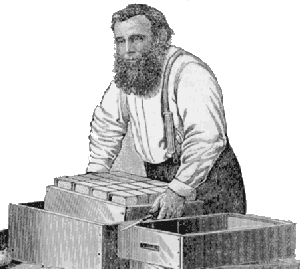
Taking a closer look at the apiarists of Toledo, we find many individuals and companies that were involved in the sale of beekeeping equipment. S. J. Griggs was once such merchant. He apparently started in the bee supply business with his brother, as early city directory entries listed the “Griggs Brothers,” but later, only S. J. The company operated from about 1904 to 1915. In the 1915 Toledo city directory, his company was listed as “Producers, Packers, and Shippers of Honey, Bees, Beekeepers Supplies, Beeswax and Poultry Feeds.” He workplace was at 521 Monroe, and from the sound of it, beekeeping must have been a substantial, although not entire, part of his livelihood.

Also listed in 1915 was Frederick W. Summerfield (1861-1947), of 730 Lorain. The directory index lists him under “apiarist,” but the alphabetical listing identified him as a “grocer.” Summerfield’s obituary confirms that he operated a grocery at the corner of Lorain and Newbury. He probably kept bees as a sideline to running the grocery, which may have been more typical of beekeepers of the time. Summerfield retired as a grocer in 1929, but maintained a “bee farm” at his retirement home on River Road in Grand Rapids until his death in 1947. Less than a career, more than a hobby, bees and the honey they produced helped feed the sweet tooth of early Toledo.

I suspect that there were many people who tried to make some extra money keeping bees, but found it not suitable, or like me, were leery of stings. E. T. Lewis and Co. was listed as “Apiarists and Manufacturers of Bee Keepers Supplies” at 36 Monroe Street from 1884 to 1887. Frederick Schroeder of Upton near Monroe lasted a single year as a beekeeper in 1917. Lewis J. Paratschek of 285 E. Manhattan sputtered along in the business from 1922 to 1925. Northwest Ohio even once boasted an apiarists’ newspaper with the florid title, “The Bee-Keepers’ Journal and Agricultural Repository.” Meant to be read by those specializing in the “Apiary for the Farm & Fireside,” it was published in Nevada in Wyandot County in 1869. It moved to New York after only a few months in Ohio.

One West Toledo beekeeper left a letter giving a glimpse of, if not his beekeeping operation, than at least his experience and a rather pugnacious attitude.

“Feb 24, 1884,
Dear Sir,
I received your letter and i send one in re turn and i want a situation to work in and apiary for a responciable man my age is 28 year old i have Handled Bees for a little over eight years i had 32 colinies fall count and i can handle Bees as good as any other man and i will not take the Back seat for any one and Don’t you forget it...A. L. Miller”

Perhaps Mr. Miller had been stung once too often, but as this letter is addressed to a beekeeper in Knowersville, New York (now part of Albany), it appears that he was trying to find a job far from his West Toledo home.

If anyone deserves the title, the “bee king” of Toledo was one Jesse Sisson. Sisson was an early arrival in Toledo, coming from New York State in 1847. Like some of our other apiarists he came to the bee trade in the second part of his life. He apparently succeeded to or bought out the aforementioned E. T. Lewis in 1886. J. Sisson and Company partnered Jesse Sisson with the colorfully named Ianthus L. Van Wormer. According to city directory information, the partnership started life at 214 Oak Street, but later occupied a “large and spacious building” at 214 Jackson. The Sisson partnership seems to have sold beekeeping equipment, rather than maintaining beehives themselves. “He makes a specialty of the U. S. Standard Honey Extractor” [a machine used “to spin honey out of the combs after they have been uncapped.”], claimed one article, and the name of Jesse Sisson, “upon any article used in bee culture is accepted throughout the United States as standard and the best made.” This may be advertising hokum, but Mr. Sisson lasted in business for a relatively long time, from 1887 or 8 to at least 1901. Shown as 75 years of age in the 1900 census, I suspect he died sometime before 1910.

Beekeeping in Toledo appears to have died out during the Depression of the 1930s. The Toledo economy has tilted more towards the manufactured item, but there are still any number of produce stands and farm markets around the area. A good many of these retailers sell farm fresh honey, made on local farms. So even if the price is a bit more, stand solid with the old beekeepers of your home, and when you buy honey, see where it comes from. Pass over the honey from Chicago or San Diego, and buy from the nearest Ohio beekeeper.

Record Pirates


Record Pirates:

Talk-o-phone Phonograph, Leeds Records Made in Toledo by Alan Borer

There is much discussion in the news lately about “burning” CDs, international copyright of music, video and audio “piracy,” and similar news. Some countries do not enforce laws, or even have a law, ensuring that royalties go to the original performer. But of course, there is “nothing new under the sun,” and Toledo was once the scene of just such piracy in the days of Victrolas, Edison Records, and talking machines.

Toledo was once was the home of a line of early disc record players known as the Talk-o-phone. Associated with the Talk-o-phone company was a record division (a “label” we would call it today) known as Leeds Records. In existence from 1902 to 1910, the two companies competed against the giant of early sound recording, the Victor Talking Machine Company (still in existence, although now called RCA). Talk-o-phone and Leeds competed for nearly a decade, but in the end fell victim, to the fact that, at its heart, the companies were the offspring of a music pirate. As Sherlock Holmes might put it, let us review the evidence.

Unfortunately the evidence is somewhat contradictory. We know from census information that Toledo was once the home of a man named Albert Irish. He lived on Monroe Street with his wife and children, and identified himself as a “real estate agent.” But in 1902, he was approached by a man with the lengthy name of Wynant Van Zant Pierce Bradley of Brooklyn, New York. Bradley, it appears, was a record pirate, having done pirate work for the Zonophone record company. Perhaps to escape attention in New York, he moved to Toledo, or made contact with, Albert Irish. Irish (possibly providing the cash) and Bradley (likely providing the insights into recording piracy), soon had Talk-o-phone up and running.

The early years of the twentieth century saw a craze for disc records. Thomas Edison was still making cylinder records, but Emile Berliner and his disc shaped records started a trend that last until records were eclipsed by CDs only about 15 years ago. There was fascination with records, recorded sound, and music, which led to a free-for-all among record manufacturers. Such issues as record size, one side or two, and licensing was all up for grabs. The fluid nature of the industry could be seen in Leeds Records.

Made in Toledo, Leeds was not the highest caliber of recording, even in 1902. It has been suggested that the recorded sound quality of Leeds was about five years behind that of Victor. The most notable thing about Leeds Records is that they were one-sided, that and they had an ornate gold label.

There is no doubt that some of Leeds Records were of recorded music originally released by others and then pirated by Bradley. International copyright at this time was poorly understood and poorly enforced, and some Leeds Records were dubs of musical performances made in other countries. But others were made on the up-and-up. For example, Leeds sold legal, original recordings of contemporary vaudeville star Byron G. Harlin. But enough of the Leeds Records were pirated to get Irish and Bradley in trouble.

Leeds was apparently a subsidiary of the Talk-o-phone Company. An odd point in this story is that Talk-o-phone records were also sold as its own label. Talk-o-phone sold phonographs starting in 1903, and sported a product line of relatively low priced machines. Bradley put quite a bit of imagination into his scheme. Talk-o-phone offered seven different machines, each named for a musician, such as the “Sousa,” and the “Herbert,” (after Victor Herbert). It may have been only a coincidence that the Herbert was Talk-o-phone’s cheapest model at $15.00, while the Sousa retailed for $40.00.

Bradley may or may not have been making a statement about the relative popularity of the composers. But his piratical eye continued to wander. Also in 1903, he introduced a dog mascot for Talk-o-phone, a shaggy dog with the motto, “Familiar Voices.” This seems to have been a direct attempt to pirate Victor’s “Nipper” and his motto, “His Master’s Voice.” Nipper is still used in RCA advertising a century later. Talk-o-phone’s unnamed dog would not survive the court fight that drove the company into oblivion.

In 1909, Victor and its team of lawyers brought suit against Talk-o-phone. The result was practically a foregone conclusion. Victor was flush with cash, Wynant Bradley was a known pirate, and Talk-o-phone had borrowed Victor’s dog, its ornate player cabinets, its recording artists, and who knows what else. Victor’s lawyers triumphed, and Toledo’s foray into the record business ground to a halt. Albert Irish continued to sell real estate in Toledo. We do not know whether he lost money in the fiasco. Bradley disappeared; if he continued as a pirate, he kept it a deep secret.

And so, Toledo lost its bid to become a center of the recording industry. A few ancient records and a few Talk-o-phones, now highly prized by collectors, are all that remain. But it was a colorful episode. Our pirates didn’t sail the waters and bury treasure; instead they brandished waxen records and kidnapped a dog in their unsuccessful brigandage.